Branding is often discussed as if it were a checklist: a name, a logo, a color palette, a tagline. In practice, it behaves less like a list and more like a system—interdependent, cumulative, and emergent. From a linguistic perspective, it functions much like a sign system: meaning is not contained in isolated units but arises through relationships among signs. The current dispute between the The Church of Jesus Christ of Latter-day Saints and the Open Stories Foundation, which produces the Mormon Stories Podcast hosted by John Dehlin, illustrates this dynamic clearly. The crux is not any single element in isolation, but how multiple elements interact to produce perceived affiliation.
In systems theory, outcomes are shaped by interactions, not just components. Linguistics makes a parallel claim: in Semiotics, a sign’s meaning depends on its relation to other signs within a system. A word does not carry fixed meaning on its own; it acquires meaning through contrast, context, and use. Branding follows the same logic. A name alone rarely defines a brand; neither does a color or a visual motif. But when these elements are combined, consistently and repeatedly, they create a gestalt, akin to a coherent discourse.
Consumers do not parse brands analytically; they process them the way they process language—pattern recognition first, analysis later (if at all).
This is where confusion emerges. It is not that any one element is proprietary or uniquely identifying. Rather, the configuration of elements begins to approximate an existing brand identity closely enough that audiences infer a relationship—much like how a sentence can imply meaning beyond the literal definitions of its words.
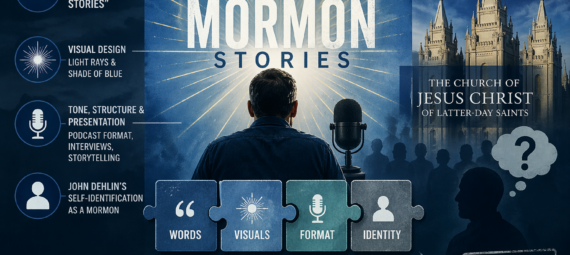
Consider the elements at issue:
- The phrase “Mormon Stories”
- Visual design cues such as light rays and a particular shade of blue
- The tone, structure, and presentation style of the podcast
- John Dehlin’s self-identification as a Mormon
Individually, these are diffuse signals. The term “Mormon,” for example, functions linguistically as a widely shared signifier with broad colloquial usage, especially among those outside the faith. A blue color palette is not inherently distinctive. Podcast formats are conventional genres with shared norms.
But branding, like language, does not operate at the level of isolated units, it operates at the level of integration. In linguistic terms, this resembles compositionality and pragmatics: meaning emerges not just from parts, but from how those parts are arranged and interpreted in context. When these elements co-occur, they form a recognizable pattern. That pattern can resemble, even unintentionally, the established identity of the The Church of Jesus Christ of Latter-day Saints, which is widely associated (particularly externally) with the term “Mormon.”
The key concept here is emergence: the idea that a system produces effects not reducible to its parts. In linguistics, a similar idea appears in pragmatics and discourse analysis, what is meant often exceeds what is explicitly said. Branding operates the same way. Audiences synthesize cues rapidly and subconsciously, drawing inferences rather than performing legal or analytical checks.
They do not ask, “Is this shade of blue trademarked?” or “Is this phrase legally protected?” Instead, they perform something closer to pragmatic interpretation: “What does this signal mean in context?”
If the answer trends toward “this feels connected to that institution,” then confusion has occurred, even if no individual element necessitates that conclusion.
Context is central in both branding and linguistics. The same signifier can produce different meanings depending on its environment:
- Within a religious discourse context, “Mormon” indexes institutional identity
- Within a personal narrative context, it signals individual background or experience
- Within a media product that adopts quasi-institutional aesthetics, the distinction can blur
The Mormon Stories Podcast operates at the intersection of these contexts—personal storytelling, religious discourse, and media production. In linguistic terms, it occupies overlapping registers. That overlap intensifies the combinatory effect of its branding elements and increases the likelihood of interpretive ambiguity.
A further complication lies in the distinction between self-reference and perceived reference. In linguistics, this parallels the difference between speaker meaning and hearer interpretation. John Dehlin’s use of “Mormon” may function as self-identification, a statement of perspective. But when embedded within a broader branding system (name, visuals, format) it can be reinterpreted as signaling institutional proximity.
Branding systems, like language systems, compress nuance. What is intended as descriptive can be received as affiliative once integrated into a larger semiotic structure.
Understanding branding as a system( both in systems theory and in linguistic terms) reframes disputes like this. The question shifts from “Is this element infringing?” to “What does the total configuration communicate?” Legal analysis often isolates elements; human interpretation does not. It evaluates composites, much like listeners interpret utterances rather than individual words in isolation.
In that gap lies the tension: a system built from individually permissible parts can still produce a collectively meaningful, and potentially confusing, signal.
This analysis is not an argument for either side. It is a structural observation about how branding (and meaning more broadly) functions. When arguments isolate individual elements (a word, a color, a design choice) and debate their permissibility, they apply a model closer to a parts list than to a sign system.
The breakdown occurs there. Branding, like language, operates through accumulation, interaction, and context. Treating it as reducible to discrete components misses how meaning is actually produced and perceived. The issue is not whether any single element is acceptable, but whether the combined system generates an identifiable and potentially confusing interpretation.