Throughout history, the stories of heroic leaders have transcended geographical and cultural boundaries, often leaving their mark on names, traditions, and legends. The names Tecun Uman, a revered K’iche’ Maya leader, and Teancum, a valiant warrior in the Book of Mormon, provide a fascinating case study. These names not only share phonetic similarities but also evoke archetypes of leadership and sacrifice, inspiring a deeper exploration of their linguistic and cultural connections.
Tecún Umán: Symbol of Leadership and Resistance
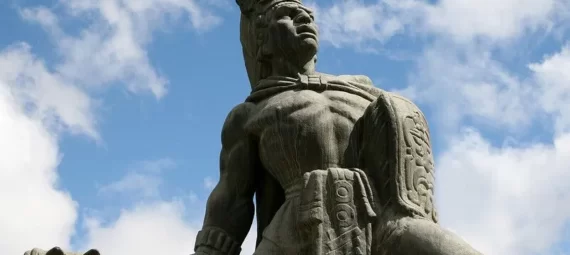
Tecún Umán holds a revered place in Guatemalan history and Maya tradition as a heroic K’iche’ leader who resisted the Spanish conquest in 1524. He is remembered as a symbol of courage, leadership, and the defense of his people during a pivotal moment in Mesoamerican history.
The origin of the name Tecún Umán remains a subject of scholarly discussion. Early K’iche’ documents refer to him as Tecum (or Tekum), while umam is generally understood to mean “his grandson” or “grandson of.”
nima rajpop achij adelantado Tecum umam rey k’iche’ don K’iq’ab’ – “Great captain-general Tecum, grandson of the K’iche’ king Don K’iq’ab’.” – Título C’oyoi
Some historians therefore interpret Tecún Umán as deriving from a phrase identifying Tecum as the grandson of the K’iche’ ruler K’iq’ab’, rather than as a literal personal name in its modern form. Other interpretations of the name have been proposed, including connections to titles associated with nobility or quetzal-feather symbolism, but these remain debated and are not universally accepted.
Tecún Umán’s status as a military and political leader is supported by K’iche’ historical traditions. The colonial Ki’che’ text, Título C’oyoi, refers to him as nima rajpop achij, often translated as “great captain-general” or “great war leader,” highlighting his prominent role within K’iche’ society.
According to both historical accounts and later legend, Tecún Umán led resistance against the forces of the Spanish conquistador Pedro de Alvarado. His death became a powerful symbol of Indigenous resistance, and he is widely regarded as Guatemala’s national hero. Today, Tecún Umán continues to represent the resilience, dignity, and enduring cultural legacy of the Maya peoples.
Teancum: A Warrior of the Book of Mormon
In the Book of Mormon, Teancum is depicted as one of the most notable Nephite warriors, known for his exceptional bravery, military skill, and unwavering dedication to his people. Teancum’s story is marked by several key episodes that highlight his strategic genius and personal courage in battle:
- Defender Against the Lamanites: Teancum played a critical role in defending the Nephites from repeated incursions by the Lamanites. His leadership and tactical acumen helped to turn the tide in several battles.
- Assassination of Morianton: Teancum’s quick action and courage are demonstrated when he personally slays Morianton, a Nephite dissenter whose rebellion threatened the stability of the Nephite nation.
- Death of Amalickiah: Perhaps Teancum’s most legendary act was his nighttime assassination of Amalickiah, the Lamanite king. In a daring and dangerous mission, Teancum infiltrated the enemy camp and ended the reign of a ruler whose ambitions posed a grave threat to the Nephites.
- Confrontation with Ammoron: Teancum’s final act of heroism came when he attempted to assassinate Amalickiah’s brother, Ammoron, to end the ongoing war. Though he succeeded in killing Ammoron, Teancum was fatally wounded in the process, sacrificing his life for the safety of his people.
These accounts portray Teancum as a figure of extraordinary valor and selflessness, embodying the qualities of a warrior-leader who prioritizes the greater good over personal safety.
Exploring the Phonetic Connection
A key link between Tecun and Teancum lies in their phonetic similarities. Examining how names evolve through linguistic shifts over time and space can reveal meaningful connections:
- Shared Root Sounds: Both names prominently feature the consonants T, C, and M/N, creating a strong auditory resemblance. In historical linguistics, the phonemes N and M often interchange over time.
- Vowel Simplification: Over centuries, vowels in names often undergo simplification or modification. The transformation from “Teancum” to “Tecun“ could be the result of a linguist process called lention in which a consonant weakens and is sometimes deleted.
These phonetic changes are typical in the transmission of names through oral traditions, particularly as they cross linguistic and cultural boundaries.
Shared Archetypes of Leadership and Valor
Beyond their phonetic similarities, Tecun Uman and Teancum embody the archetype of the courageous warrior-leader. Both figures are remembered for their dedication to protecting their people against external threats. Tecun Uman’s symbolic resistance against the Spanish invaders is often depicted in artistic representations that highlight his spiritual and royal connection through the resplendent quetzal feathers in his attire. Similarly, Teancum’s heroic deeds in the Book of Mormon emphasize his strategic brilliance and willingness to sacrifice for the greater good.
This shared archetype strengthens the possibility that these names may reflect not only linguistic connections but also cultural parallels in their representation of resistance, leadership, and sacrifice.
Could Tecun Have Evolved from Teancum?
If Tecun originated from Teancum, the linguistic evolution might have occurred through:
- Geographical Spread: Names often change as they move across regions and linguistic groups. Phonetic shifts may result from adaptation to local dialects or language evolution.
- Oral Transmission: The repetition of names in storytelling can lead to gradual simplification or modification to suit the phonology of the speakers.
- Cultural Evolution: The simplification of “Teancum” to “Tecun” may have been driven by a preference for streamlined pronunciation or symbolic reinterpretation.
Such transformations are not uncommon and often reflect the interplay between language, culture, and historical events.
While the phonetic similarities between Tecún and Teancum, along with the shared themes of leadership, warfare, and sacrifice associated with both figures, make for an intriguing comparison, it is important to recognize the limits of the evidence. At present, there is no established academic consensus supporting a historical or linguistic connection between the K’iche’ Maya figure Tecún Umán and the Book of Mormon warrior Teancum. The similarities discussed here should therefore be understood as speculative rather than demonstrative.
Historical linguistics requires rigorous methods, including documented patterns of sound change, evidence of language contact, chronological plausibility, and supporting textual or archaeological data. While it is possible to imagine pathways through which names might evolve and transform over time, the observations presented in this essay do not constitute proof of such a relationship. Considerably more research would be required before any proposed connection could be evaluated as a serious linguistic hypothesis.
Nevertheless, exploring these kinds of possibilities can be intellectually rewarding. Thought experiments that compare names, traditions, and heroic archetypes across cultures often encourage deeper engagement with history, language, and mythology. Even when a proposed connection ultimately remains unproven, the process of investigation can illuminate the rich ways that different societies remember their heroes and preserve their stories. In that spirit, the comparison between Tecún Umán and Teancum is best viewed not as a settled conclusion, but as an interesting question that invites further study and reflection.