Why Systems Matter in Theology
Every theological tradition carries implicit assumptions about how reality works. Some assume that moral and spiritual outcomes follow predictable patterns: obedience yields blessing, disobedience yields punishment, belief yields salvation. Others assume something more dynamic—that growth, holiness, and joy emerge over time through interaction, struggle, and adaptation.
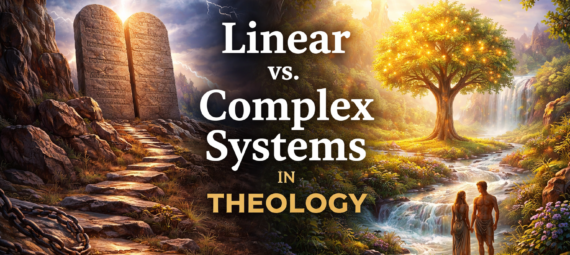
Systems theory gives us language for this distinction. Linear systems emphasize proportional causality and predictability. Complex systems emphasize emergence, feedback, and development. When applied to theology, this distinction clarifies why the worldview articulated in The Church of Jesus Christ of Latter-day Saints differs so sharply from many Christian traditions—not merely in doctrine, but in underlying structure.
At the center of that difference stands 2 Nephi 2.
Linear Theological Systems in Broader Christianity
Much of Western Christian theology, particularly in Augustinian, medieval, and Reformation traditions, operates within a largely linear framework:
- Humanity sins → justice is offended
- Christ atones → justice is satisfied
- Faith is exercised → salvation is applied
Even when grace is emphasized, the structure remains transactional. Salvation functions as a verdict rendered once certain conditions are met. Moral life is important, but primarily evidentiary—it confirms rather than produces transformation.
Similarly, in strongly predestinarian traditions, outcomes are fixed by divine decree. Human choices may reveal election, but they do not meaningfully shape the system itself. From a systems perspective, humans are components acted upon, not co-creators of outcome.
These models excel at clarity and assurance, but they tend to minimize developmental becoming. Growth is secondary; status is primary.
The Law of Moses as a Deliberately Linear System
The Law of Moses provides a scriptural example of an explicitly linear theological system. It was designed to teach obedience through clarity, repetition, and external enforcement:
- Keep commandment → receive blessing
- Break commandment → incur penalty
Its pedagogical value was real. It formed communal identity, disciplined behavior, and externalized righteousness in visible ways. However, both the Hebrew Bible and later Christian scripture are clear about its limits.
The law could:
- Define sin
- Regulate behavior
- Preserve covenant boundaries
But it could not:
- Transform desire
- Produce holiness
- Create inward righteousness
This is not a failure of the law; it is a function of its design. Linear systems are effective at instruction and control, but they do not generate emergence. Obedience under the Law of Moses produced conformity, not transformation. That is why the law was always described as preparatory.
2 Nephi 2 as a Theology of Complex Systems
Against this backdrop, 2 Nephi 2 is striking. Lehi does not merely exhort obedience; he explains the conditions under which righteousness, agency, and joy can exist at all. The chapter functions as a metaphysical account of reality rather than a moral checklist.
Opposition as Structural Necessity
Lehi’s declaration that “there must needs be an opposition in all things” is not rhetorical flourish. Opposition is presented as ontological necessity. Without it, righteousness, wickedness, holiness, and misery all collapse into meaninglessness.
In linear systems, opposition is a problem to be solved. In 2 Nephi 2, opposition is the engine that makes moral meaning possible. A system without tension cannot produce distinction; a world without contrast cannot produce growth.
Agency as Emergent Rather Than Instrumental
Agency in many traditions exists primarily to justify judgment. In 2 Nephi 2, agency exists to make becoming possible. Choice is not merely evaluative; it is creative.
Lehi insists that if outcomes were compelled, righteousness would cease to exist—not because of disobedience, but because obedience without alternatives is not obedience at all. Agency here is emergent: it arises from the interaction of law, opposition, desire, consequence, and uncertainty.
The Fall as Entry Into Moral Complexity
Lehi’s treatment of the Fall is one of the most distinctive features of LDS theology. Eden is not a lost ideal of moral maturity, but a static state incapable of growth. Mortality introduces time, risk, suffering, and irreversibility—the very conditions necessary for development.
Righteousness is not possible before the Fall, not because of sin, but because righteousness requires lived contrast. The Fall marks the transition from a simple system to a complex one.
Law as an Enabling Constraint
In 2 Nephi 2, law does not negate freedom; it makes freedom intelligible. Where there is no law, there is no sin—and therefore no righteousness. Law defines the boundaries within which agency can operate meaningfully.
This mirrors complex systems in the natural world, where constraints enable creativity rather than suppress it. Law does not mechanically produce righteousness; it creates the space in which righteousness can emerge.
Joy as Emergent, Not Dispensed
Lehi’s culminating claim—“men are, that they might have joy”—is not a promise of guaranteed happiness. Joy is not an output of obedience. It is an emergent outcome of sustained engagement with opposition, agency, law, and redemption over time.
Joy cannot exist without real risk, real failure, and real suffering. In 2 Nephi 2, joy is inseparable from complexity.
Rethinking Doctrine and Covenants 130:20–21
Doctrine and Covenants 130:20–21 is often read through a linear lens:
Obey law → receive blessing
At first glance, this appears indistinguishable from the Law of Moses. Yet when read alongside 2 Nephi 2, a different structure emerges.
In a complex system, law does not dictate outcomes; it governs what kinds of outcomes are possible. Blessings are not rewards handed out for compliance, but natural consequences that emerge as individuals align themselves with eternal realities.
Two individuals may obey the same law and experience different results because context, intent, timing, and interaction matter. Obedience is necessary, but it is never sufficient by itself.
Thus, D&C 130 does not reintroduce linear moral mechanics. It affirms that reality is lawful—but that law operates developmentally, not transactionally.
Why the Latter-day Saint System Is Fundamentally Different
Taken together, these elements reveal that LDS theology is not simply a variation on traditional Christian themes. It rests on a different underlying architecture:
- Salvation is developmental, not declarative
- Law enables growth rather than enforcing outcomes
- God governs by sustaining conditions, not overriding agency
This explains why obedience alone never guarantees righteousness, why opposition is preserved rather than eliminated, and why progression remains central even after covenant commitment.
From Obedience to Becoming
The Law of Moses taught obedience. Linear systems enforce behavior. But 2 Nephi 2 teaches becoming.
When read as a theology of complex systems, Latter-day Saint doctrine coheres around a single premise: God’s purpose is not to produce compliant subjects, but to cultivate beings capable of sustaining moral complexity, meaningful agency, and enduring joy.
Righteousness cannot be mass-produced—even by perfect rules. It can only emerge in a world where opposition is real, agency is inviolable, and law creates possibility rather than certainty.