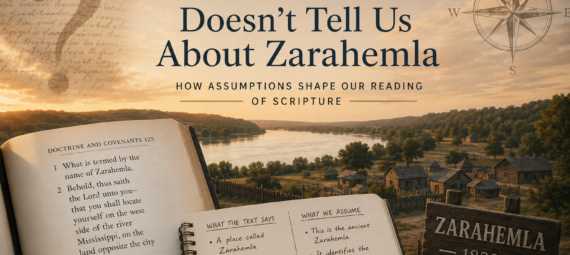
Few passages in the Doctrine and Covenants have generated more confidence than their wording actually warrants. Doctrine and Covenants 125 is one example. For many Latter-day Saints interested in Book of Mormon geography, the revelation is often treated as if it settles an important historical question: the location of the Book of Mormon city of Zarahemla.
It doesn’t.
The interesting thing is not simply that the revelation fails to identify the Book of Mormon city. The more interesting question is why so many readers assume that it does. The answer reveals something important about how all of us read scripture.
Reading What Isn’t There
Doctrine and Covenants 125 states:
Let them build up a city unto my name upon the land opposite the city of Nauvoo, and let the name of Zarahemla be named upon it.
Notice what the revelation actually says.
It refers to a place that was that was given the name of Zarahemla. It gives instructions to the Saints regarding settlements on the Iowa side of the Mississippi River opposite Nauvoo. It tells them what to do with that settlement.
What it never says is that this place is the same location as the Zarahemla described in the Book of Mormon.
That conclusion requires an additional premise, one the revelation itself never supplies. Many readers move almost effortlessly from, this settlement is called Zarahemla to therefore this must be the ancient city of Zarahemla.
But those are not the same statement.
The Power of Assumptions
Ben Spackman has argued that many disagreements about scripture arise because we mistake our assumptions for the text itself. We often believe we are reading scripture “literally” when, in reality, we are reading it through an inherited set of expectations.
A genuinely literal reading asks a different question:
What did the author intend to communicate? That is different from asking, what conclusions can I build from this statement? Those are related questions, but they are not identical.
In the case of D&C 125, Joseph Smith’s purpose appears remarkably practical. The revelation concerns where the Saints should settle and how they should organize themselves. Its focus is ecclesiastical and logistical, not archaeological.
The revelation simply employs the name by which the settlement was already known.
Names Are Not Historical Claims
History is full of places named after older places. There is a Paris in Texas. There is a Rome in Georgia. There is a Memphis in Tennessee. No one assumes these names establish the location of the ancient cities.
Likewise, nineteenth-century Americans frequently borrowed biblical and classical names for new settlements. Zion, Salem, Athens, Lebanon, Corinth, and dozens of others appeared across the expanding United States. A settlement named Zarahemla fits comfortably within that naming tradition.
To conclude that the name alone identifies the location of the ancient Book of Mormon city is to ask the text to say something it never actually says.
The Difference Between Evidence and Inference
This distinction is worth emphasizing. The evidence is straightforward:
- There was a nineteenth-century settlement named Zarahemla.
- Doctrine and Covenants 125 refers to that settlement.
- The revelation gives instructions to the Saints living there.
Everything beyond that belongs to inference. Some inferences may ultimately prove correct. Others may not. But good interpretation requires us to distinguish carefully between what the revelation states and what we infer from it. Confusing those two categories often creates unnecessary certainty.
Reading Scripture on Its Own Terms
This pattern extends far beyond D&C 125. Every reader approaches scripture carrying assumptions about history, language, genre, prophecy, and revelation. Those assumptions often operate invisibly. Because we are unaware of them, they feel like the “plain meaning” of the text. Yet what seems obvious to one generation frequently appears far less obvious to another.
As Spackman has noted, understanding scripture requires recognizing that ancient and modern authors wrote within particular historical, cultural, and literary contexts. A “literal” reading is not simply taking words at face value. It is seeking the meaning the author intended to communicate, even when that meaning differs from our first impression.
This is why careful readers continually ask:
- What assumptions am I bringing to this passage?
- Does the text actually say what I think it says?
- Am I reading the words, or am I reading my conclusions into the words?
Those questions are not signs of skepticism. They are signs of humility.
Holding Our Conclusions with Appropriate Confidence
None of this proves where the Book of Mormon city of Zarahemla was located. Nor does it disprove any proposed geography. Instead, it reminds us to match our confidence to our evidence.
If additional historical, archaeological, or textual evidence supports a particular model, it should be evaluated on its own merits. But D&C 125 should not be asked to bear more weight than it actually does.
The revelation gives inspired counsel to nineteenth-century Saints. It does not explicitly identify the location of the ancient Book of Mormon city. Recognizing that difference is not diminishing scripture. It is respecting it. Sometimes faithful interpretation means allowing a text to say exactly what it says, and resisting the temptation to make it answer questions it was never intended to answer.